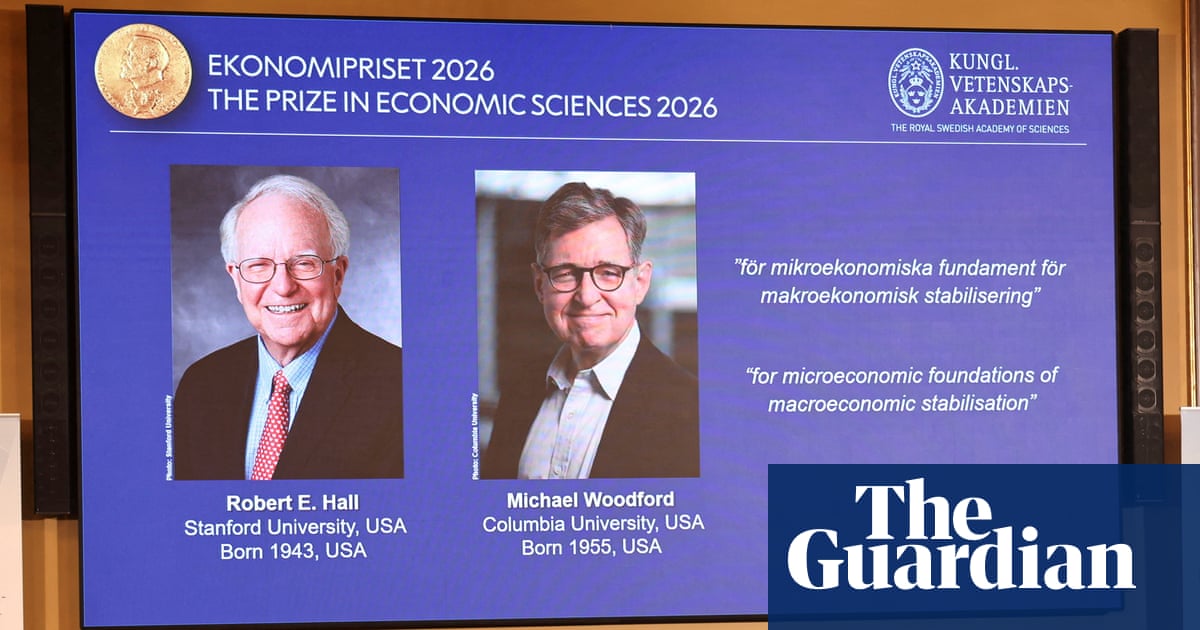
Two American economists, Robert Hall and Michael Woodford, have been awarded the 2026 Nobel Prize in Economic Sciences for developing models that help policymakers stabilise economies, the Nobel committee announced on Monday.
According to reporting in the Guardian, Hall is affiliated with Stanford University and Woodford with Columbia University. The prize recognises their work on the microeconomic foundations of macroeconomic stabilisation, producing models that give central bankers and finance ministers better guidance for smoothing economic peaks and troughs.
What the winners developed
Hall and Woodford were cited for models that examine how monetary and fiscal policy can be used to counter disruptive economic fluctuations. Their research provides theoretical frameworks for how policy actions can limit long recessions and prevent runaway inflation, offering a clearer basis for policy design and implementation.
The work links individual economic behaviour to aggregate outcomes, producing tools that policymakers can use to assess trade-offs and anticipate the effects of interventions. The Guardian described the contribution as giving policymakers improved tools to stabilise their countries’ economies.
Why the prize matters
The award highlights an ongoing policy challenge: balancing measures to revive weak demand without triggering excessive inflation, and using fiscal responses effectively during downturns. By formalising how policy affects macroeconomic stability, Hall and Woodford’s models aim to reduce the risk that temporary shocks become long-lasting crises.
Central banks and finance ministries routinely confront decisions about interest rates, liquidity support and fiscal stimulus. The models recognised by the prize feed into the intellectual toolkit that informs those decisions, shaping debate about when and how to act during economic stress.
The Nobel committee’s choice also underscores the prominence of theoretical work that connects micro-level behaviour to macroeconomic policy, reinforcing the role of rigorous modelling in public economic management.
Broader context
This year’s award follows a recent pattern of Nobel recognition for research that directly informs policy responses to economic instability. Policymakers and academics often draw on such frameworks when designing interventions aimed at smoothing consumption, stabilising employment and anchoring inflation expectations.
Reporting on the prize noted its practical implications for averting deep recessions and runaway inflation, themes that remain salient for many economies still managing the aftermath of recent global shocks.
The winners were announced on Monday; details on the prize citation and the Nobel committee’s full statement were provided in contemporary press coverage.